11/15/16

Kyoto Day Trips: Hiroshima and Miyajima


Two world heritage sites in one day may not seem like such a big deal when visiting Japan. However, quality is more important the quantity and this is without a doubt the most powerful trip you can make while in the country. The artifacts and personal stories at the Peace Memorial Museum are quite moving, which is a massive understatement. Essentially, you’ll be fighting the urge to vomit and cry all at the same time. The idea of how ridiculous it would be to lose it will help you keep it together, at least until you see a grown man with tears in his eyes exit the exhibit. Then, your only salvation will be quickly (and quietly) streaming YouTube videos of cute puppies falling down stairs.

About an hour away from the tragic memorials of Hiroshima, stands one of the most unique and beautiful shrines in Japan. Miyajima shrine is famous for its massive tori gate, which stands stoically in the harbor. At low tide, the ground beneath the gate is completely dry and many people can be seen walking under its giant arch. However, the gate is most beautiful at high tide when its reflection can be seen bouncing off the water below it. Being able to experience both of these great heritage sites in one day is an unforgettable experience and an absolute must if you have the chance.

Hiroshima


You’ll want to start your day in Hiroshima. From the train station, take the sightseeing tour bus to Peace Memorial Park and hop off. You’ll see the museum in front of you, start there and then work your way through the park. The entrance fee to the museum is quite cheap, only $200 JPY per person. Actually, this price is reasonable when you realize that you’re paying money to make yourself cry and feel like a terrible human being. That said, don’t skip the museum. It doesn’t take long to walk through and it’ll give you a better understanding of the other memorials in the park, allowing you to appreciate them more.

As I’ve already said, the museum is a little bit of an emotional strain. Its display cases of burned clothing, body parts and personal stories have a more profound effect than the actual Dome. The most moving story archived in the museum is of Sadako Sasaki. She was two years old when the bomb went off and (unlike her sister) appeared to have fortunately survived the blast. She went on to have a perfectly normal life, excelling at sports and sports.

Suddenly, Sadako developed leukemia as a teenager. There’s an old Japanese belief that if you fold 1,000 paper cranes, your wish will come true. Sadako did this and her tiny, perfect paper cranes are on display at the museum. Very few people look at them with dry eyes. Sadako died, but her paper cranes survived and started a movement. Even today, thousands of paper cranes pour in from all over the world and are hung at the Children’s Peace Memorial, which stands across from the museum.

After exiting the museum, the Children’s Peace Memorial will be the next thing you see. The first thing you notice about it will be the colorful long dresses hanging behind the memorial. Upon closer inspection, you’ll see that these are actually countless numbers of paper cranes. Some of them (most of them probably) are made in Japan, but they come from everywhere, including from schools in the United States. (Imagine how cool that class would be: Let’s learn how to make origami and then send it to honor children located, literally, around the world.) We were fortunate enough to see groups of school children adding even more strands of cranes to the memorial. Seeing their innocent faces memorializing the dead was enough to make us lose it again and we had to walk/run away.

From the Children’s Peace Memorial, the next part of your visit is the actual Dome, which was located directly under the small sun created by the bomb. These are the original remains and you don’t have to look closely to see the warped iron and scorched brick from the blast. It’s still hard to imagine that this damage happened in a matter of seconds, not decades. Thanks to your time at the museum, you’ll understand just how powerful the blast was, you’ll know that no one was spared and how some people were incinerated from the inside out.

After learning why you’ll never support anything remotely nuclear, it’ll be time for lunch and you’re in the perfect place for it. The Dome is right beside one of Hiroshima’s more popular downtown shopping streets. Just walk down until you see Hondori Shopping Street and turn there. You’ll find the local fare of katsu, ramen and sushi, but you’ll also see some cute little cafes. There’s even a Starbucks hidden away down in the subway entrance, which was great for us. Hiding out in a dark corner with some chocolate and coffee was the perfect way to hit the reset button on the day.

We reemerged topside about an hour and a half later ready to go. Wait around and head back to Hiroshima station around two in the afternoon to head to Miyajima.  If you have some time to kill, check out some the stores on the shopping street before catching the bus back to the station. After a little exploring, you’ll see that there’s more to Hiroshima than just its history. It has turned itself into a nice, clean city with an eclectic vibe.

Miyajima 


To get to Miyajima, catch the local train at Hiroshima station and get off at Miyajima. It’s a about a 45 minute ride to get there and the trains run every ten to fifteen minutes.  From Miyajima station, walk down to the ferry. You’ll be able to see it from the station exit. It’s just a five minute walk away. The ferries, also, run every ten to fifteen minutes and will take you straight to Miyajima. Once on the ferry, you’re basically there. It’s just a short, fifteen minute ride to the island.

Miyajima is much more than a Tori Gate. There is a proper temple complex, pagoda and even a gondola if you’re interested. The island is, also, crawling with deer. Thankfully, they are a little better behaved than the deer at Nara and just as cute. Hang out, watch the tide roll in and explore until five thirty. At this time, you’ll need to catch the ferry again and head back to Hiroshima station for dinner.


Okonomiyaki 

As we learned, Hiroshima station is home to some great eateries and makes for an awesome place to try the local specialties. Restaurants are located on the second floor of ASSE, one of the malls attached to the station. Take this chance to try okonomiyaki. It’s a local dish that is directly associated with the Hiroshima area and it’s pretty good. Basically, the dish is made with everything you could want: fried egg, bacon, noodles, lettuce, bean sprouts, etc.

The best part is that all of the things listed above come standard, but then, you can add more! You can request your okonomiyaki to be made with shrimp, oysters, cheese or whatever else the cooks have hiding behind the counter. Hiroshima is also famous for its oysters, so I tried the local dish with the local fish. Honestly, not a fan and I picked most of the oysters out. Minus the slimy oysters, the okonomiyaki by itself was delicious. I would definitely order it again just maybe with shrimp next time. It’s hard to go wrong when eating in Japan. After a hearty meal, it’ll be time to start your journey back to Osaka and/or Kyoto.

Getting Around


Everything is covered by the JR Pass. Literally, everything is covered, including the sightseeing bus in Hiroshima and the ferry in Miyajima. It’s great! If you have the pass, this will be one of your cheapest days in Japan. In fact, I probably wouldn’t attempt it without some sort of discount train pass. In addition to the JR Pass, there’s at least one more area specific pass (the Kansai Hiroshima Area Pass) that you can get, but it won’t work on the ferry or bus. It, also, will not cover your journey from Kyoto. Essentially, passengers using this pass have to begin and end their trip in Osaka, which is where the pass takes effect.

To get to Hiroshima on time, you will need to take a Hikari train from Kyoto at eight in the morning or from Osaka at 8:30. This is a high speed train that will take you straight to Hiroshima station. You’ll arrive in the city around ten o’clock so prepare for a late lunch.

Getting to Hiroshima from Kyoto is easy. Getting back is slightly more difficult. There is no direct train that goes from Hiroshima to Kyoto. You will have to take a train to Osaka and then transfer. This is not a big deal. It’s very easy to get a local train from Osaka to Kyoto and the ride only lasts about half an hour. The local trains run every ten to fifteen minutes.

Let’s talk about the elephant in the room: getting from Hiroshima to Osaka. You will have to take a Kodama or Sakura train. There is no Hikari train available for this part of the trip. Make sure you get a Sakura train. It’s slower than a Hikari, but still bearable. A Kodama train is doable, but it is insufferably slow, as we learned the hard way. It’s one thing to stop at every station. It’s another thing entirely to stop at every station and then wait around five minutes for no reason. Thank goodness for the internet. If possible catch your return train home around 7:50 or 8:00 at night.

You can reserve these tickets in advance and I suggest that you do. To reserve seats, just show up at any JR station help desk with your rail pass and they’ll help you find the seats. Again, make sure you’re on a Sakura train for the second part of the trip.

11/7/16

Hiking Taroko National Park


Make time for Taroko. You can get in most of the highlights in a day for very little cost. Of course, Taroko Gorge is a massive canyon that was made by the Taroko river, which lets out in the Pacific Ocean. As you ride through (by bus or taxi), you’ll see beautiful marble cliffs, boulders and long thin waterfalls, which vaguely resemble veins inside the cliffs. You’ll also zoom in and out of tunnels that are cut right into the marble. There are some beautiful walking trails in Taroko as well that are easy to access by bus or taxi. Also, there’s no entrance fee for the gorge itself, which is kind or crazy. I guess they make enough money off of the buses.

If you get hungry while up in the gorge, Buluowan and the Taroko Visitor Center both offer some food choices as well as other public facilities. The receptionists at the Visitor Center speak wonderful English and are very helpful. They can call you a taxi as well as help you organize your trip by letting you know which trails are closed. (This proved very useful on our trip since last minute rock slides can literally put a bump in your plans.) FYI, you can hire a taxi chauffeur for an entire day for about $2,500 NTD and the receptionists will even help you bargain.

While visiting the gorge, I recommend staying in Hualien, but make sure you’re somewhere near the Taroko bus stop, which is right behind the Hualien train station. Buses leave for the gorge hourly, starting at seven o’clock. The tickets are expensive for Taiwan, but still decently priced. You can get a day pass for $250 NTD or a two-day pass for $400 NTD. The bus will take you straight to the visitor center and then continue on, stopping at different trail heads and scenic spots. Be warned, the last bus leaves the Visitor Center for Hualien at 5:20 in the evening. On holidays and weekends, it is recommended to just buy a cheaper one-way ticket from the bus driver to the Taroko Visitor Center and from there hire a taxi. Otherwise, you risk spending half of your precious time waiting on buses that are too crowded to stop.

If you would rather stay in the gorge, itself, Silks Place is a popular choice and it’s also located near a bus stop. That’s it. If you make it down to Hualien, check out this great BBQ place and get the ribs. Hualien is, also, just a great place to explore. While walking around, we would casually stumble into many treasures such as this cultural and creative park. This massive complex is entirely dedicated to local artisans and performance artists. The first night we happened upon a giant craft fair. Of course, we went back the next night and sat down to enjoy an intense street fire dancing performance.

Shakadang Trail

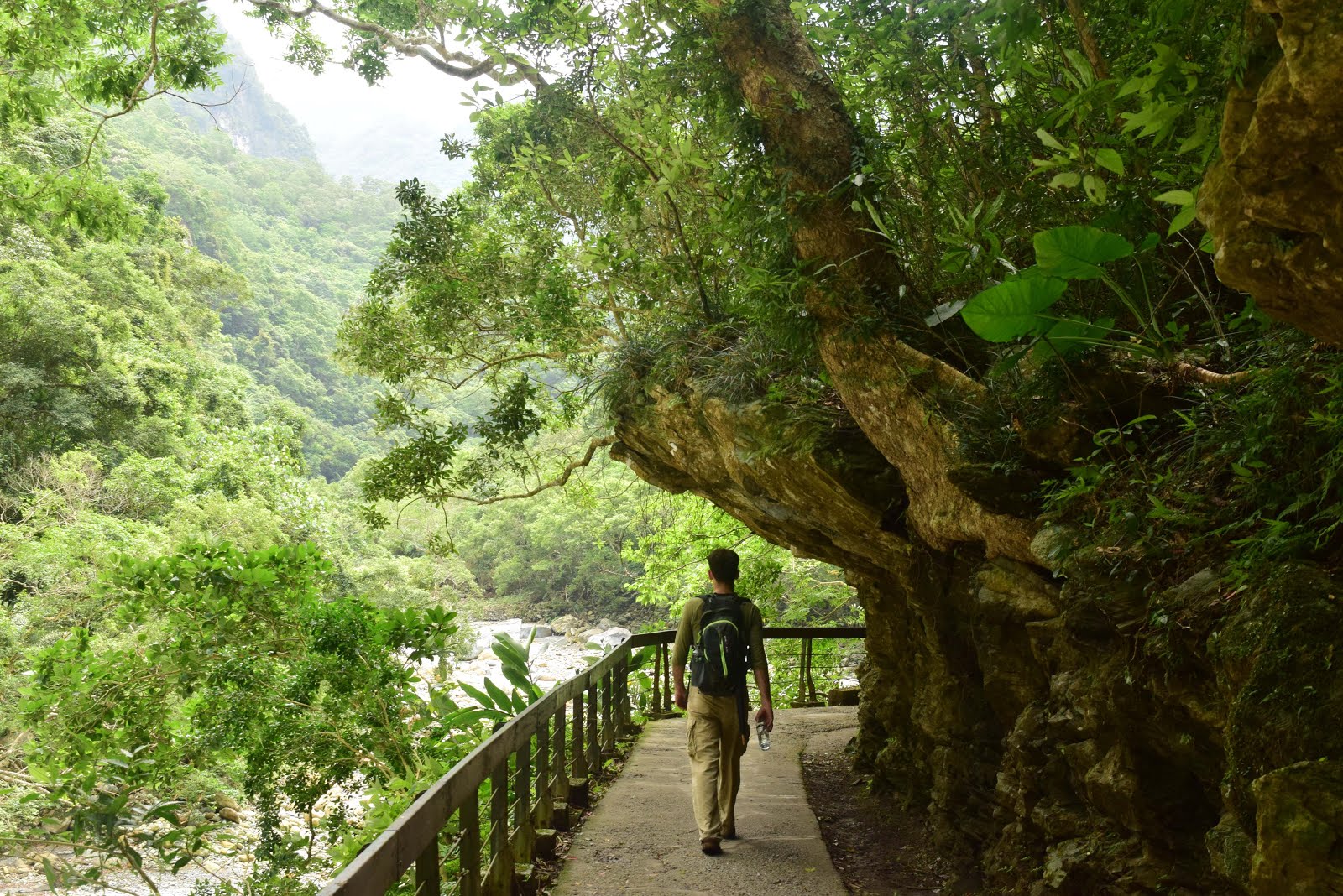
This leisurely walk is the most popular trail in the gorge and for good reason. The trail is cut right into a cliff that follows the Taroko river. At 3D cabin, which is where most people stop and turn back, you can take a dip in the river and relax on the marble boulders. The path is shaded and there is a cool breeze that comes off the river.

The whole trail will take you two to three hours depending on how long you stay to play in the river. The trail is also very easy to access. The Taroko bus will let you off right at the trail head or you can walk to the trail from the Visitor Center. There isn’t a public restroom on this trail so you may want to stop in and use the restrooms at the Visitor Center anyway.

Swallow Grotto and the Tunnel of Nine Turns (Yanzikou & Jiuqudong)


This trail is often referred to as the best of the gorge and if you’re looking for views of the marble cliffs, then it is. I highly recommend this trail if it’s your first time at the gorge. It’s a very easy walk and it weaves in and out of one of the most amazing tunnel systems that the gorge is known for. Plus, there’s even a public bathroom facility located along it. Bring your own toilet paper though.

These two trails are side by side and very easy to access. Just get off the Taroko bus at the stop for Swallow Grotto and walk. You can walk both trails in about an hour, but then I suggest turning around and back tracking to catch the bus again at Swallow Grotto. There is a bus stop at the end of the trail, but buses hardly ever stop there due to crowding.

Eternal Spring Shrine (Changchun Shrine)


This is an absolutely beautiful spot. You can walk around, take pictures, grab something to drink, use the bathroom and just relax for a bit in the presence of the shrine. There is a trial that goes up to and behind the shrine, but it’s nothing special. If you’re bored, go for it. If you’re strapped for time, skip it. You’re not missing much.

Qingshui Cliffs


You’ll need to take a taxi to see these, but they are a must visit while at the gorge. The beautiful cliffs are slammed right up against the Pacific Ocean. You can have the visitor center call a cab for you. A trip to the cliffs and back should cost around $1,000 NTD. A good cab driver will take you to two or three scenic overlooks that offer breathtaking views of the cliffs and the true blue waters beneath them.

Other Trails


Along with these, there’s also Baiyang Waterfall trail, Zhuilu Old Road and the Lushui Trail. I highly recommend the Baiyang Waterfall trail. It’s a tunnel trail that ends with a beautiful waterfall curtain. Unfortunately, it was closed while we were there (stupid rock slides). Zhuilu Old Road is the best hiking experience in the gorge. I highly recommend it as well. You have to get a couple permits, but it’s worth it. Just plan ahead. You, also, need a permit for the Lushui trail, but this is supposedly very easy to obtain and you can grab it the day of. I don’t know much else about this trail other than it’s a loop and sounds cool. We were going to hike it if we had time.

10/31/16

Hiking Zhuilu Old Road


The best hike in Taroko Gorge, Zhuilu Old Road, offers the thrilling experience of standing over two thousand feet in the air above Taiwan's most famous gorge. The hike itself and the views from the cliff will leave any hiker feeling exposed to the sublime (aka. standing over something that is both beautiful and deadly). In fact, just a month before our trip, a hiker was caught in a gust of wind and fell to his death from the cliffs. Backing up to more mundane things, the trail was started by the aboriginal tribe living in Taroko Gorge about a century ago. Later, during their occupation of Taiwan, the Japanese developed the trial a bit more. Unfortunately, they used it to subdue the local Taroko people.

In spite of its ugly history the old road is beautiful. To access the trail, you have to plan ahead of time. You cannot just show up and hike. The national park locks it up tight and only people with the correct paperwork can get in. To get started on the paperwork, apply online for the first permit you need to access the trail. In total, you will need to apply for two permits. The earlier you start, the better, as they only allow about 60 people on the trail per day. You can apply online here.

To complete this application you will need your passport number (or ARC number), the address of where you are staying in Taiwan and a Taiwanese friend who will agree to be your emergency contact. If you’re staying at a hostel or hotel, see if you can enlist someone in management or at the reception desk to help you. Your contact does not have to be Taiwanese, but they do need to have a local phone number that is based in Taiwan. There is a possibility that someone will call and confirm the number with your contact. You will also need your contact’s national ID number and birthday.

Currently, the trail is only open for the first three kilometers. This is perfectly fine as the best views are at the beginning of the trail anyway. On the first page of the online application map your route as follows: Zhuilu Suspension Brigdge - Badagan Outpost - Cliff Outpost - Badagan Outpost - Zhuilu Suspension Bridge. Once you’ve completed the application, you will receive an email approving your permit within three days. It’s very fast. Again, there is a limit on how many permits are issued per day so it is best to apply earlier rather than later. Upside, there won’t be more than around 60 people on the trail at any given time. Not only does this help preserve the natural environment, but it also means most of your hike will be in relative privacy.

After receiving the first permit online, print out three copies. One is for you to keep, one is for the police office at Taroko and the last one is for actually entering the trail. On the day of your hike, try to get an early start and be at the trail head no later than ten in the morning. This means you should get to the Taroko visitor center by nine o’clock. At the visitor center, go to the police station and fill out the paperwork for the second permit needed to enter the trail. The station is located a short walk down the road from the actual tourist visitor center. You’ll probably see police cars parked out front. At the station, show your identification and the printed hiking permit. In return, they will give you the second hiking permit. It’s as simple as that. The whole process is very fast and completely painless. If the officer behind the desk in especially slow, it might take ten minutes.

Once you have the second permit from the police station, make your way to the trail head. There are two ways to do this. First, you can head to the visitor center and they will call a taxi to take you there. Alternatively, you can go to the Taroko bus stop. The buses run every hour and they do stop at the Zuilu Old Road trail head. It’s the same stop as Sparrow Grotto and you can see the entrance from the bus stop.

At the trail head, show your paperwork and identification to the gate keeper and he’ll unlock everything for you. (That’s right. This trail is cool enough to have a gate keeper. With suspension bridges, tunnels, ruins and cliffs, the only thing missing is the fairies.) After making everyone jealous with your apparent magical powers over the gate keeper, enjoy the hike. It’s not for the faint of heart, but the path is clearly marked. There’s no need to worry about maps or getting lost and there’s certainly no need to pay for a tour guide. The whole hike takes three to four hours. Be warned, there are a lot of stairs.

10/10/16

Doctors in Taiwan: Gynecologist


One a year, ladies are required to visit a local sadist and get our plumbing checked. It’s quite important actually. The gynecologist will check for tumors, cysts, diseases, etc. Any kind of doctor visit in Taiwan is fairly inexpensive and going to the gynecologist is no exception. For your first visit, expect to pay around $600 NTD or $20 USD. This includes your registration fee as well as the cost of the appointment. Without an insurance card, expect to pay a bit more, but this is still cheap compared to Western standards.

Unfortunately, some of the quality goes down with the price. In Taiwan, the breast exam is completely omitted. I guess they expect us to do that on our own time. (Like any of us actually know how to tell a cancerous lump from any of the other stuff going on in there.) Also, you are not expected to undress completely. This shouldn’t be much of a surprise since the doctors appear to have a fear of breasts.

The gynecologist will be quick and efficient though when it comes to getting your pap smear done. So much so that you’ll feel a bit more like an animal at the vet than a girl visiting the doctor. Upside: the appointment only lasts about five minutes and you can be on your way. Just don’t expect any coddling or patience when it comes getting those legs spread. The gynecologist should email you the results of the pap within two weeks.

I can personally recommend the Jung Shiao Shing Fu Clinic (Zhongxiao Xingfu OB/GYN), which is conveniently located near a great shopping center. After suffering through a completely impersonal 10 minute appointment, at least you will be able to reward yourself with a new shirt from Zara. Also, all the doctors there speak English and I think most (if not all) of them are women. (In case that matters to you.)

To get there, take the blue line to Zhongxiao Dunhua MRT station and use exit 2. After exiting the station, just walk straight for a little while (it’s not far) until you see a round shaped bank building in front of you and a Rolex place beside you. Turn there. It’s that building. Enter from the side and take the elevator to the 12th floor. If you’re not sure you’re at the right place, just hold up the address below to some strangers on the street and look confused. Taiwanese people are generally very nice and will help you.

One last note, it may be worth booking your appointment in advance. It appears that the clinic accepts both walk-ins and appointments. However, having an appointment should speed things along so you can get out and get to Zara faster. Here is the current address (as of 2016):

Jung Shiao Shing Fu Clinic
235 Zhongxiao E. Rd
12 F
Taipei City
02-2776-2222

10/3/16

Dogs in Taiwan: Superstitions, Expectations & Trends

Taiwanese people tend to have a very superstitious nature and because of this have a few terrible beliefs when it comes to dogs. For example, if a dog is solid black and stray, it will most likely be killed and eaten. If the dog is solid black with white paws, it will just be killed. These markings are considered unlucky and no one wants to risk catching the contaminated luck by eating the poor animal. Unfortunately, many people in Taiwan still believe in this nonsense and won’t hesitate to tell you about it. In their defense, there are quite a few wild dog packs in the city and in the mountains and yes, some of these dogs are too far gone to be rehabilitated into a home.

Strays are a big concern for Taiwan. When the mining towns closed and people migrated to the city, many dogs were abandoned. There are not very may large predators in Taiwan and, consequently, there are now a number of packs roaming the mountains. It is not uncommon to run into them and they can be aggressive. Certainly, don’t try to pet them, but I haven’t heard of them actually killing anyone. Occasionally, someone does come back with a few scratches and a bite mark though. There are even some of the packs in Taipei proper. Again, approach with caution. One last thing, apparently, it’s not unknown for dog owners to take their family pet into the mountains and let go after getting tired of it. For this reason, family dogs are no longer allowed in national parks, such as Kenting, Yangmingshan and Taroko.

Some people and organizations are trying to improve the situation. There’s at least one catch and release spay and neuter outfit going around. If the volunteers think a dog has a chance at being adopted, they will do their best to find a foster home for the animal. There are, also, half a dozen different animal shelters in Taipei alone. The big government shelter located in Neihu seems to be the most popular. However, Taiwan has its own SPCA and there’s a shelter called Animals Taiwan. If you’re thinking of adopting, try following these groups on Facebook. They regularly update their feeds with available pets. There’s another organization that frequents the big flower market under the expressway on Saturdays. They always have the cutest puppies on display.

The requirements for owning or fostering a dog in Taiwan are quite lax compared to the United States. No one expects you to have a fenced in yard or hours of free time. If you can buy your pet food and take it for a half hour walk everyday, you’re good to go. Of course, you will have to train your dog to use a designated pee pad. Also, the lack of exercise may make it crazy and bark all the time. So be honest with yourself and your responsibilities before you decide to take on a pet. If people did this to being with, the shelters would be far less crowded. For example, golden retrievers were popular in Taiwan a few years ago, but few people realized how big they would get. (The Taiwanese idea of a big dog is about 30 pounds.) Consequently, many of them ended up in the shelters. A word of advice: Try fostering first. The SPCA is always looking for a new foster family and they even pay for everything until the dog is officially adopted. Also, if you don’t speak Chinese, it’s not a problem. They are very nice and helpful.

Dog Parks

If you do decide to adopt, owning a dog in Taiwan is easy and inexpensive. There are a number of popular dog parks with designated free roaming areas. The best one is called the “number four” park and is a short walk from Yongan Market MRT Station on the orange line. (You can't miss it. It's the park with the big library in the middle of it.) At the parks, you’ll see unleashed dogs running around and having fun, especially on a Saturday afternoon. They’re great places to go and the people are very friendly. In fact, they are sometimes too friendly, but never mean. There are even a number of dog cafes in the city, and many restaurants will welcome a well-behaved pooch. I can personally recommend Tiere Pet Hotel, which doubles as a doggy day care. It’s great. People get to eat food and give dogs some attention while their owners are away.

Pet Hotels

If you need to board you dog while on a trip or just for an afternoon, there are lots of places to choose from, including Tiere Pet Hotel and Pet Pet, which is near the number four park. Pet Pet is cheaper and fine for a short term stay. If you’re going on a longer trip though, spring for Tiere Pet Hotel. They will send you Line updates, wash your dog and let it play with the customers in the cafĂ©. For a small fee, they will even pick up and return your dog to your apartment. Again, if you don’t speak or write Chinese, it isn’t a problem. Someone on staff will be able to help you. Prices run between $500 and $1000 NTD per night. That’s around $12 to $30 USD, which is pretty good compared to prices back home.

Veterinary Appointments

Veterinary appointments are around the same price actually. Like boarding houses, they are extremely common and there’s bound to be at least one within walking distance of your apartment. Frontline and Heartgard are inexpensive as well. (If your dog spends any amount of time outside get Frontline. It’s the only thing strong enough. Concrete does not mean no fleas.) You can get a six month supply of each for about $2000 NTD or $60 USD. These can be found at your local vet and maybe even at your local pet store.

Pet Supply Stores

Pet supply stores are also very common and offer a wide selection of high end products, including KONG, Science Diet and other brands. I can recommend Mixed Pet Shop, Hapet, Sophie Dog and Pet Park. Hapet, Sophie Dog and Pet Park are all chain stores that you can find throughout Taipei. Mixed Pet Shop is cute little shop near the Dinxi MRT Station. All the proceeds go toward helping shelter dogs and there’s also a dog training studio above the store.

When it comes to buying food, get a Costco card. (That’s right. Taiwan has a Costco.) This could potentially save you up to $2,000 NTD a month. The most expensive bag of food at Costco is $1,500 NTD and will feed one medium sized dog for two and half months. At specialty pet supply stores, the same bag would, literally, be double the price. The cheapest bag at Costco is around $600 NTD. You won’t find dog food at this price anywhere else in Taiwan.


Apartment Expectations

If you live in an apartment, there are a few things to be aware of. First, if your dog barks loudly and often, you may be fined. Second, if you put feces in your trash bin, instead of in the organic waste pile, you might be fined. These are easy problems to fix. Just recycle the poop along with any other organic matter properly. A barking issue may be slightly more difficult to fix. If your dog is just barking (and not tearing up your apartment), consider giving your pet more exercise or trying a shock collar if things things don’t improve. I know it’s inhumane, but it’s a lot better than ending up back at the shelter.

If your dog is barking and tearing up the apartment, you may need to buy a kennel. Don’t worry, these are relatively cheap. You will have to hunt around, but you can find a large kennel for about $1000 NTD. Then buy some blankets to go in and on top of the kennel. Basically, turn it into a den for your dog. Then, of course, you will have to kennel train you dog. Here in Taiwan, if you’re dog needs to be kenneled for seven to eight hours, it isn’t considered to be a huge problem. Again, it’s terrible, but doable and a lot better than being back at the shelter.

Trends

The most popular dogs in Taiwan are (without a doubt) poodles and Shiba Inus. People here love their little bundles of pure-bred fluff. Their owners will cut crazy designs into their fur, dress them up and then push them around in strollers. (Don’t Judge! I wouldn’t want my baby walking around barefoot on a city sidewalk either.) Other popular dog breeds include the corgi and french bulldog. Since owner’s can’t cut shapes out of their fur, they settle for cutting designs into it. My favorite so far has been the batman logo. Can’t tell you how much hair cuts and baths cost, but they can’t be too expensive. I know a nail trim only costs around $50 NTD or $2 USD. Also, doggy salons can be found all over the city.